
You’ve thought about it for months. Maybe years.
Becoming a yoga teacher. Teaching others. Deepening your own practice. Transforming your life through authentic yoga knowledge. But the questions keep coming: Is Rishikesh really the best place? Will 200 hours be enough? Can I afford it? What will my life actually look like there?
Here’s the truth: thousands of people ask these exact questions every year. And thousands enroll in 200 hour yoga teacher training programs in Rishikesh. Not because it’s a trend, but because it works.
Rishikesh has been the yoga capital for over 5,000 years. The knowledge here is authentic. The teachers are legitimate. The transformation is real.
But before you book that flight, you need real information. Not marketing hype. Not Instagram romance. Just facts.
This guide explains everything you need to know before enrolling in 200 hour yoga teacher training in Rishikesh—from what you’ll actually learn to how much it costs to whether it’s the right choice for you.
Table of Contents
Why Rishikesh is the Yoga Capital of the World
Rishikesh isn’t just another yoga destination.
It’s the birthplace of yoga as a systematic practice. The Ganges River flows through it. Ancient temples line the banks. Spiritual seekers have come here for millennia—not as tourists, but as genuine students.
Here’s what most people miss: the energy here is different. You can feel it the moment you arrive. The entire city is organized around yoga, spirituality, and inner practice. Not around hotels and restaurants (though those exist too).
This creates something crucial: an environment where deep transformation is possible. Your nervous system recognizes this. Your mind settles. Your practice deepens faster than it ever has.
Listen closely—this isn’t mysticism. This is practical reality. When your entire environment supports your practice, when you’re surrounded by others committed to the same journey, when teachers have trained here for decades… transformation becomes the default, not the exception.
The Ganga River itself has significance. For over 5,000 years, yoga practitioners have come to this specific location. That continuity matters. That history creates a particular quality of practice you simply can’t replicate elsewhere.
What is 200 Hour Yoga Teacher Training (YTT)?
The 200 Hour Yoga Teacher Training (also called 200 Hour YTT or YTTC) is a comprehensive program combining physical practice, philosophy, anatomy, and teaching methodology.
It’s the international standard established by Yoga Alliance. If you complete 200 hours, you’re recognized globally as a yoga teacher. But here’s what matters: the training is about much more than certification.
The reality: a 200 hour program is intensive immersion. You’re not attending evening classes while working. You’re completely committed to practice for 4-8 weeks straight. You wake early for meditation. You practice asanas (poses). You study pranayama (breathing). You learn yoga philosophy. You understand anatomy. You learn how to teach others.
This intensity is intentional. It creates transformation that casual yoga classes can’t touch.
Most programs run 4-6 weeks full-time, though some offer part-time options spread over 6-12 months. The 200 hours is the minimum established by Yoga Alliance. Many serious programs actually offer 250-300 hours because the material requires that depth.
Want to know the truth? A quality 200 hour program is more valuable than a decade of casual yoga classes. The structure, the immersion, the authentic teaching—it changes everything.
The Complete Curriculum: What You’ll Actually Learn
Here’s what most of the legitimate 200 hour yoga teacher training in India
actually teaches:
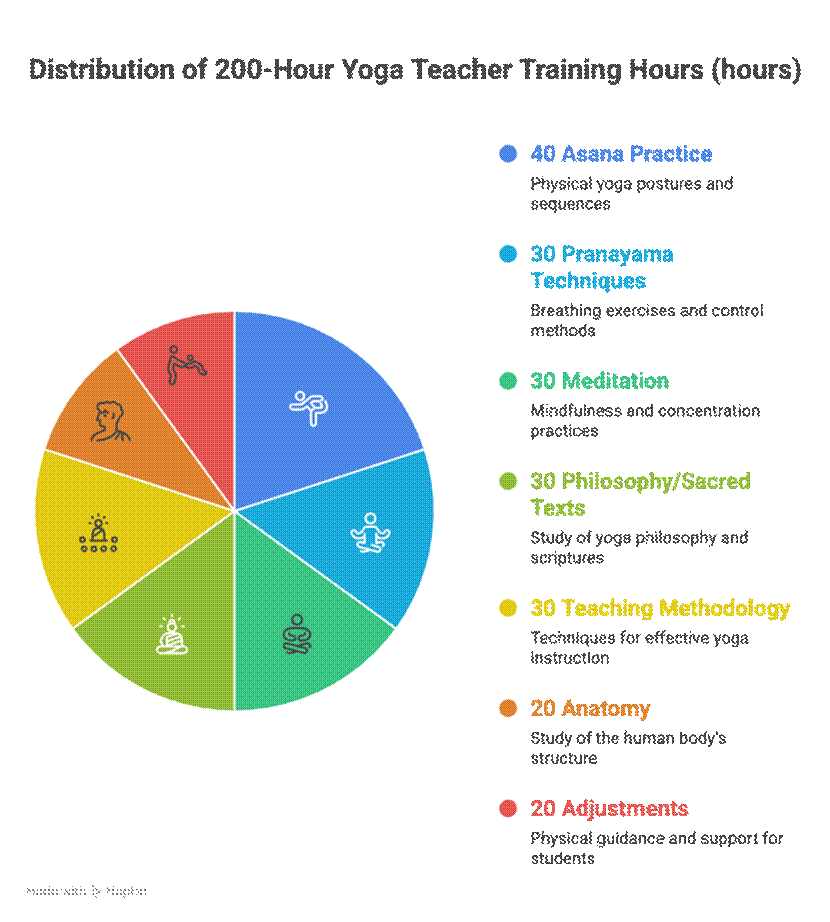
Asana Practice (60-80 hours): Physical postures. Not just learning poses, but understanding alignment, modifications, contraindications, and how poses affect different body types and conditions.
Pranayama (20-30 hours): Breath control techniques. Different pranayama practices create different effects on your nervous system. You’ll learn why, when, and how to teach each one.
Meditation and Philosophy (30-40 hours): Yoga philosophy isn’t theoretical. It’s practical wisdom about how your mind works and how to train it. You’ll study the Yoga Sutras, the Bhagavad Gita, and other foundational texts.
Teaching Methodology (20-30 hours): How to actually teach yoga. Class structure, cueing, adjustments, timing, managing different student levels. You’ll teach practice classes to your peers with feedback from experienced teachers.
Anatomy (20-30 hours): Human anatomy as it relates to yoga. Skeletal structure, muscles, joints, how different bodies move differently. This prevents injuries and allows you to teach safely.
Here’s what makes this different: you’re not just learning information. You’re transforming your own practice while learning to teach. By the end, you understand yoga at a depth that casual students never reach.
Cost Breakdown: Budget for Your Training
Let’s talk money because everyone wants to know this.
Program cost (tuition): $1,200 – $3,500 USD depending on the school. Budget schools run $1,200-$1,800. Mid-range quality schools run $2,000-$2,800. Premium schools with experienced teachers and excellent facilities run $3,000-$3,500.
Accommodation: $200-$600 per month. Budget ashrams offer shared rooms for $200-$300. Mid-range schools offer private rooms for $400-$500. Luxury options run $600+. Most programs include accommodation in the cost.
Meals: Usually included in your program cost. If not, $3-$5 daily (food in Rishikesh is incredibly cheap).
Flights: Depends on where you’re flying from. From the US typically $800-$1,500 round trip. From Europe $600-$1,200. From Australia $1,000-$1,800.
Miscellaneous: Yoga mat, props, travel insurance, visas, personal items. Budget $500-$1,000.
Total realistic budget: $2,500-$5,000 for everything including flights. Many people spend $3,000-$4,000 total.
Here’s what matters: this is genuinely affordable when you consider what you’re getting. A month-long immersive training with certified teachers, accommodation, meals, and worldwide certification—this is incredible value. For comparison, a similar program in the US costs $5,000-$8,000.
Duration and Schedule Options
Most 200 hour programs run 4-6 weeks full-time, with intensive daily practice and study.
A typical day looks like:
- 6:00 AM: Meditation and pranayama
- 7:30 AM: Yoga asana practice
- 9:00 AM: Breakfast
- 10:00 AM: Philosophy/anatomy classes
- 1:00 PM: Lunch and rest
- 3:00 PM: Teaching methodology or practice teaching
- 5:00 PM: Personal study/practice
- 6:00 PM: Dinner
- 7:30 PM: Evening meditation or lecture
- 9:30 PM: Sleep (you’ll need it)
Some schools offer flexible schedules: part-time training spread over 3-6 months if you can’t commit full-time. Some offer weekend intensives. Some combine online theory with in-person practice.
The reality: full-time immersion works better. Part-time schedules extend the program but reduce the transformational intensity. If possible, commit to full-time.
Most programs run year-round with new batches starting monthly. Peak seasons (October-March) fill faster. Off-season programs (April-September) are easier to get into and sometimes cheaper.
Finding the Right School and Teacher
This is crucial. Not all 200 hour programs are equal.
What to look for:
Teacher lineage: Where did your teachers train? How long have they practiced? Were they trained in Rishikesh? Legitimate teachers have authentic training, not online certifications.
Teaching experience: How many years has the lead teacher been teaching? Not just practicing, but actually teaching students? Ten years minimum is ideal.
Curriculum depth: Does the program go deep into philosophy, anatomy, and teaching methodology? Or is it mostly physical poses?
Student reviews: Real reviews from people who completed the program. Look for people mentioning transformation, depth, and authentic teaching—not just “nice vacation.”
Class size: Smaller is better. 15-20 students per teacher allows personalization. Classes with 40+ students are too large for quality learning.
Facility quality: Does the space feel authentic? Are there proper yoga halls, meditation rooms, library? Or does it feel like a tourist resort?
Post-training support: Do they help you find teaching jobs? Offer continuing education? Provide alumni community? Good schools support you after training.
Accreditation: Is the school registered with Yoga Alliance? This matters for worldwide recognition.
Want the truth? Research at least 5-10 schools. Read reviews carefully. Contact teachers directly. Ask questions. The right school will feel right when you find it.
For authentic, traditional training, yoga teacher training in rishikesh programs that have been operating for 10+ years with experienced lineage teachers consistently produce the deepest transformations. Look for schools emphasizing traditional methods alongside modern teaching skills.
Accommodation and Living in Rishikesh
Most programs include accommodation with tuition.
What to expect: simple but clean. Shared or private rooms depending on your budget. Basic amenities. Usually within walking distance or short walk to the yoga school.
The reality of Rishikesh: it’s not luxury, but that’s the point. You’re there to practice, not vacation. The simplicity actually supports deeper practice by reducing distractions.
Neighborhoods worth knowing: Muni Ki Reti (spiritual heart, quieter), Ram Jhula area (more touristy, restaurants/shops), Swarg Ashram (sacred, quiet, best for serious practice).
Cost of living: incredibly cheap. A meal costs $1-3. Local transportation is $0.50-2. You could live on $10-15 daily if needed, though $20-30 is more comfortable.
Staying safe: Rishikesh is safe for visitors. Standard travel precautions apply. Don’t flash expensive items. Stay aware of surroundings. Most yoga students have zero safety issues.
Internet: decent WiFi in most programs and throughout Rishikesh. If you need to work remotely, it’s manageable.
Daily Life During Training
Here’s what actually happens day-to-day:
You wake at 5:30 AM (yes, really). By 6:00 AM you’re sitting in meditation. Your mind fights this for the first week. By week two, you crave it.
Yoga practice is next. Intense, focused, transformative. You’ll be sore the first week. By week two, you’re stronger than you imagined. By week four, your body has completely reorganized.
Listen closely: this physical transformation is profound. People often lose 10-15 pounds, gain muscle definition, improve flexibility, and feel stronger and more energized than they have in years. The physical practice rewires your entire body.
Classes are interspersed with study—philosophy, anatomy, teaching methodology. You’re learning constantly.
Meals are communal. You’ll eat with classmates from 20+ countries. Friendships form fast. By the end, these people are like family.
Evenings include meditation, lectures, personal study, or free time. You might explore Rishikesh, visit temples, sit by the Ganga.
The rhythm becomes your life. Work stress fades. Your nervous system settles. Sleep deepens. Energy increases. Mental clarity emerges.
By week two, most people stop missing their regular lives. By week four, they can barely imagine returning.
Certifications and What They Mean
After completing 200 hours, you receive a Yoga Alliance RYT-200 (Registered Yoga Teacher) certification if your school is registered.
Here’s what this means: You’re recognized as a qualified yoga teacher globally. Studios will hire you. You can teach legally in most countries. You’re credentialed.
But here’s what matters more: the certification is proof of training, not proof of being a “good” teacher. Some excellent teachers don’t have formal certification. Some certified teachers aren’t great.
The real value is what you learned and how you transformed. The certificate just documents that you completed legitimate training.
Want the truth? After 200 hours, you’ll still be a beginner teacher. Seriously. Real mastery takes years. But you’ll have a solid foundation and the credentials to teach professionally.
Many teachers continue with 300 hour or 500 hour advanced trainings. These deepen your knowledge and increase your earning potential.
After Training: Career Paths and Options
So you’ve completed training. Now what?
Teaching in studios: Most common path. Start at $20-$40 per class, increase to $50-$100+ as you gain experience. Teaching 5-10 classes weekly provides income.
Corporate classes: Growing market. Companies pay $100-$300 per class. Often better pay, less competition.
Private sessions: Premium income. $50-$150 per hour depending on location and experience.
Online teaching: Build a following, offer classes globally. Income scales with your audience.
Yoga retreats: Lead retreats, earn a percentage of revenue. Some teachers earn $1,000-$5,000 per retreat.
Combining practices: Yoga teacher + massage therapist, yoga + nutrition coaching, yoga + life coaching. Combined services earn more.
Advanced training: Some teachers pursue 300 or 500 hour trainings to deepen expertise and increase rates. 300 hour yoga teacher training in India and 500-hour-yoga-teacher-training-rishikesh programs open additional earning and teaching opportunities.
The reality: Most yoga teachers don’t become wealthy. But they build fulfilling careers helping others while maintaining flexibility and doing work they love.
Many teachers describe the work as “getting paid to live their purpose.” That matters more than the money.
Is 200 Hour YTT Right for You?
Here’s the honest question: should you enroll?
Enroll if:
- You’re genuinely interested in deepening yoga practice
- You want to teach or consider teaching
- You’re ready for intensive personal transformation
- You can commit 4-6 weeks fully to training
- You’re willing to invest in yourself
Don’t enroll if:
- You want a vacation (it’s not—it’s intense work)
- You’re unsure about commitment (that uncertainty usually indicates you’re not ready)
- You’re running from something (training reveals this, making it harder)
- You’re just following a trend (it won’t satisfy you)
The real truth: if you’re reading this, part of you already knows you should do it. That intuition is usually right.
Thousands of people have completed 200 hour training in Rishikesh and described it as life-changing. Not because it’s magical, but because committing fully to yoga practice for months creates genuine transformation.
Your nervous system calms. Your mind clears. Your body strengthens. Your relationships improve. Your clarity about life direction increases.
These aren’t promises. They’re documented outcomes from thousands of practitioners.